

University of Guelph professor Dr. David McCarthy has been awarded $1.65 million over six years from the Natural Sciences and Engineering Research Council (NSERC) Collaborative Research and Training Experience (CREATE) program.
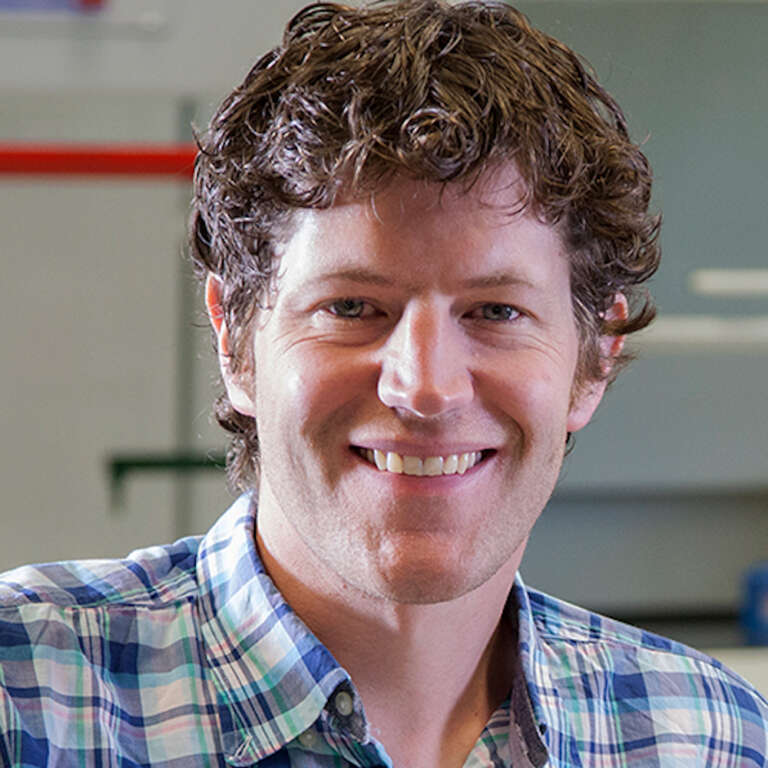
The funding will train highly qualified personnel at the undergraduate, master’s, PhD and postdoctoral levels using Internet of Things (IoT)-based environmental sensing to advance Canada’s resilience against environmental challenges that threaten our water security, increase food risks and harm ecosystems.
McCarthy, professor in the School of Environmental Sciences, Ontario Agricultural College and Canada Excellence Research Chair (CERC) in Waterborne Pathogens, is leading the new training program, along with U of G colleague Dr. Huiyan Li, co-applicants Drs. Niko Hildebrandt and Katherine Bujold at McMaster University, and Drs. Peter Vanrolleghem and Elena Torfs at Université Laval.
The multidisciplinary program, called CREATE-eSENSORs, will train the next generation of experts in IoT-based environmental sensing, real-time monitoring and control.
“This investment from NSERC will drive the application of knowledge to solve real-world problems and build resilience across Canada,” says Dr. Shayan Sharif, interim vice-president, research and innovation. “Thanks to the collaborative efforts of our researchers, partners and funders, the CREATE-eSENSORs program led by Dr. McCarthy will train dozens of future leaders with the hands-on technological skills needed to not only succeed in their careers, but to help strengthen Canada’s preparedness against environmental challenges.”
“University of Guelph researchers are consistently at the cutting edge of sustainability solutions for a rapidly changing world,” says Guelph MP Dominique O’Rourke. “Congratulations to Dr. David McCarthy and thank you for your role in developing early warning systems that help communities prepare for extreme weather events while creating economic opportunities and protecting our environment.”
Enhancing resilience to environmental challenges
eSENSORs is a six-year program, starting in September 2026, to strengthen the technology and experts available to monitor and respond to environmental threats like extreme weather in real time, with a focus on water.
Students will work across multiple fields, including engineering, health sciences and policy, to develop innovative sensing technologies that can monitor water supplies and track water quality, predict floods, detect waterborne diseases and control spills in watersheds.
“This funding means we can create a training experience that goes far beyond the typical graduate program with individuals who will make real-world impacts sooner, whether they continue in academia or transition to industry or government,” McCarthy says.
McCarthy and team have set three key goals for the training program:
- assemble a critical mass of IoT, sensor and environmental monitoring and analytics expertise in Canada
- graduate 50 highly qualified personnel to have impactful careers in environmental management
- and build a lasting Canadian ecosystem of knowledge that values interdisciplinary training and academia/industry collaboration.
eSENSORs will equip graduates with industry-relevant experience that includes project management, mentorship, networking, technical and professional training, internships, commercialization and knowledge translation.
“The funding supports a sustained pipeline of job-ready graduates to bridge the research-to-implementation gap,” says McCarthy. “Our industry partners consistently identify this area as a hiring challenge in the Internet of Things sector that’s projected to grow by 25% per year through 2032.”
The eSENSORs program takes place at the three partnering universities and sites of numerous collaborators and partners, including field sites managed by conservation authorities, international academic research labs and R&D facilities of industry partners.
The training program is further strengthened through an international network of academic collaborators at the Technical University of Denmark, TU Delft, University of Sheffield, University of Texas at Austin and Queensland University of Technology. Industry and government partners include Edinburgh Instruments, Southern California Coastal Water Research Project, A.U.G. Signals, Affinité Instruments, Aquanty, Ausable Bayfield Conservation Authority, Ontario Ministry of the Environment, Conservation and Parks, and the Ontario Water Consortium.
Other U of G researchers receive NSERC CREATE funding
As part of this announcement, three U of G researchers are working on projects led by other universities and supported by the NSERC CREATE program.
- Dr. Monica Cojucaru, professor in the Department of Mathematics & Statistics, College of Computational, Mathematical and Physical Sciences (CCMPS), is a co-applicant on the project CREATE Mathematical Innovations for Precision Public Health (CREATE-MIPPH), led by York University
- Dr. Zeny Feng, professor in the Department of Mathematics & Statistics, CCMPS, is a co-applicant on the project CANSSI Genomic Data Science CREATE, led by the University of Toronto
- Dr. Mohammad Al Janaideh, professor in the Department of Mechanical Engineering, College of Engineering, is a co-applicant on the project NSERC CREATE in Sustainable offshore and onshore Wind energy for green societies: Intelligent operation, early Fault Tracking, and environmental alignment (SWIFT), led by Memorial University