
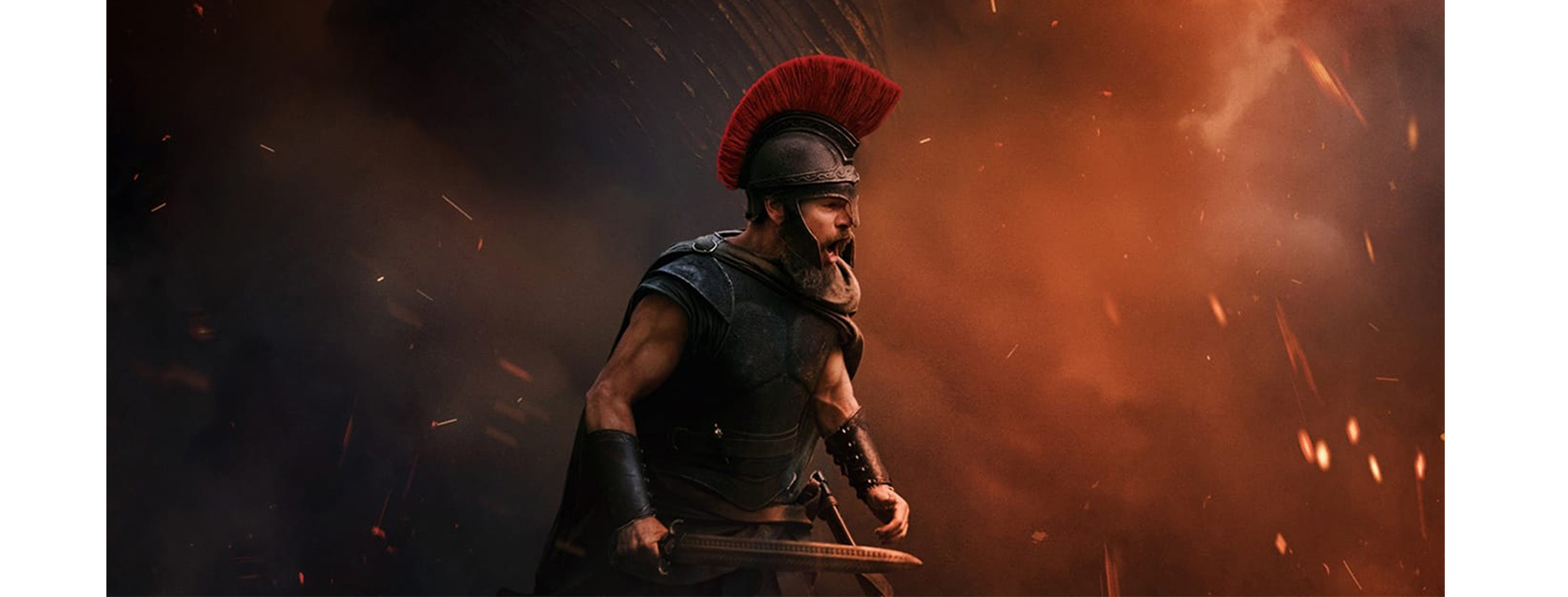

Home is not merely a place; home is where someone still knows who you are.
No matter the format of its retelling, The Odyssey, the harrowing tale of a 10-year journey home first written as an epic poem and then later adapted for the screen and stage and even podcasts, maintains its heart and, in doing so, its legacy.
University of Guelph classics professor Dr. John Walsh, of the School of Languages and Literature, shares his thoughts on the Christopher Nolan film, the most recent adaptation of the story by Homer, the ancient Greek poet.
On adaptation
Delighted to see that someone had the confidence to make The Odyssey on this scale, Walsh says it is perfect for the big screen.
“It is a huge story, with gods, monsters, storms, war, family, revenge, longing and the struggle to get home,” he says. “It should feel enormous, and there is something quite moving about seeing that world on a cinema screen.”
Because many people first encounter the story when they are young, he says they carry their own private version of the Cyclops, the Sirens, Ithaca and the sea. A film cannot replace that imagined world, but it can meet it, he says. “Part of the pleasure is seeing where another person’s imagination agrees with your own and where it takes you somewhere unexpected.”
On legacy
So much storytelling has absorbed the structure of The Odyssey, Walsh says, giving later artists a framework strong enough to survive transformation. A missing parent, a waiting spouse, a child growing up in the shadow of an absent hero, a dangerous journey, visiting the dead, a return in disguise, the test of recognition – these patterns are everywhere.
The story’s legacy is not one of duplication; Homer has survived nearly 3,000 years of rewriting, translation, argument, classrooms, Hollywood and scholars. “The more important legacy is that they have kept changing it.”
On modernization
Odysseus is much more interesting than a conventional action hero, Walsh says. His intelligence, bravery, charm, resourcefulness and emotion make him complex. And complexity is always essential to good character development.
The finer details, like using American accents, or contemporary phrasing – Telemachus calls Odysseus “Dad” – are artistic choices that challenge the notion the classical past belongs to a particular class, culture, accent or appearance. All English is modern beside Homeric Greek, Walsh reminds us.
“A good adaptation should bring us close to the characters without making their entire world identical to ours,” he says, adding even Homer’s own poems are incongruent. “Greek mythology was never fixed in one authorized form and some of the greatest adaptations look and sound nothing like ancient Greece. That is what a living tradition does.”
On relatability
“Homer feels modern because we are still ancient,” Walsh says.
The story is not simply about whether Odysseus can reach Ithaca. It is about whether someone who has spent years surviving through disguise, cunning and violence can return to being a husband, parent and ruler, Walsh says.
“This is why it still resonates. Our technologies have changed, but our basic dramas have not. We still leave, wander, lie, love, fight, lose people, idealize home, and return altered by what happened away from it. The poem survives because 3,000 years have changed our world more than they have changed us.”
Walsh is available for interviews.
Contact:
Dr. John Walsh
waljo@uoguelph.ca