

Ontario Veterinary College research finds new genetic marker for osteosarcoma
Both human and animals battling a deadly bone cancer may see new hope, as a University of Guelph research team makes advances at the Ontario Veterinary College.
The Dog Osteosarcoma Group – Biomarkers of Neoplasia (DOGBONe) is bringing together experts across veterinary and human health to create earlier and more accurate blood tests for the aggressive bone cancer known as osteosarcoma.
“Osteosarcoma primarily affects children and young adults, with Terry Fox being one of the most well-known cases,” says Dr. Geoffrey Wood, U of G pathobiology professor and co-leader of DOGBONe.
Currently, human treatment involves chemotherapy and surgery, with a survival rate of 60 to 75% if the cancer has not already spread at the time of diagnosis. However, about a third of patients may relapse as the cancer metastasizes, and 80% of these patients may die within five years – a survival rate that has not changed significantly in over 30 years.
Today’s diagnostic methods pose challenges. They involve examining a tumour under a microscope and assigning it a grade based on its appearance, a method that aims to predict how patients will respond to treatment, but one that is not always accurate. There is also no way to detect metastases until they are already apparent with imaging such as CT scans.
Dog research to help both human and animal cancer patients
A different approach is being taken at OVC. Instead of using cells or mouse models, researchers are studying pet dogs with this cancer, discovering that certain molecules, known as microRNAs, might better predict how these patients fare in the clinic.
“At the genetic and clinical levels, the cancer is nearly identical in both dogs and humans,” Wood says, explaining that osteosarcoma is a painful cancer in older and larger dog breeds, and is about 10 times more common in dogs than in humans, spreading much more rapidly.
“But this biological similarity creates a powerful opportunity to advance research that benefits both species.”
Dr. Alicia Viloria-Petit, biomedical sciences professor and co-leader of the interdisciplinary group, says: “In the past decade, advancements in cancer biology, biomedical engineering and clinical trials have led to the discovery of genetic markers that are helping us better understand how the disease progresses.”


Dr. Alicia Viloria-Petit (left) and Dr. Geoffrey Wood
New genetic marker in dogs points to new hope for cancer patients
A relatively recent discovery, microRNAs helped earn U.S. scientists the 2024 Nobel Prize in Medicine. They are gaining popularity as a potential tool for the early detection of cancer spread. Present throughout the body, these small molecules control how cells grow and behave. In many cancers, levels of certain microRNAs in the blood are much higher than usual.
Wood’s recent study published in PLOS One found a specific microRNA elevated in dogs with osteosarcoma that was associated with shorter survival times and faster disease spread. “We are actively working to turn this discovery into a quick and practical test that can help owners and veterinarians make important treatment decisions,” Wood says.
Knowing a dog’s survival chances helps pet owners and veterinarians make decisions on whether to rely on chemotherapy or to focus on palliative care to ensure the patient’s quality of life.
These results are now being applied to the human version of the cancer. One solution the DOGBONe team is working towards is a “lab-on-a-chip system” to measure key molecules in the blood of human patients. Dr. Huiyan Li, a biomedical engineer and professor at the College of Engineering, is overseeing the assembly of this detection system.
Lab-on-a-chip systems are a relatively recent technology and can perform tasks usually done by full laboratories. Injected with a blood sample, they contain microscopic channels that test microfluids as they flow through them.
COVID-19 tests are one simpler example of this system, as the DOGBONe team aims to create a “made in Ontario” equivalent for prediction of osteosarcoma metastasis.
Interdisciplinary project connects survivors with scientists
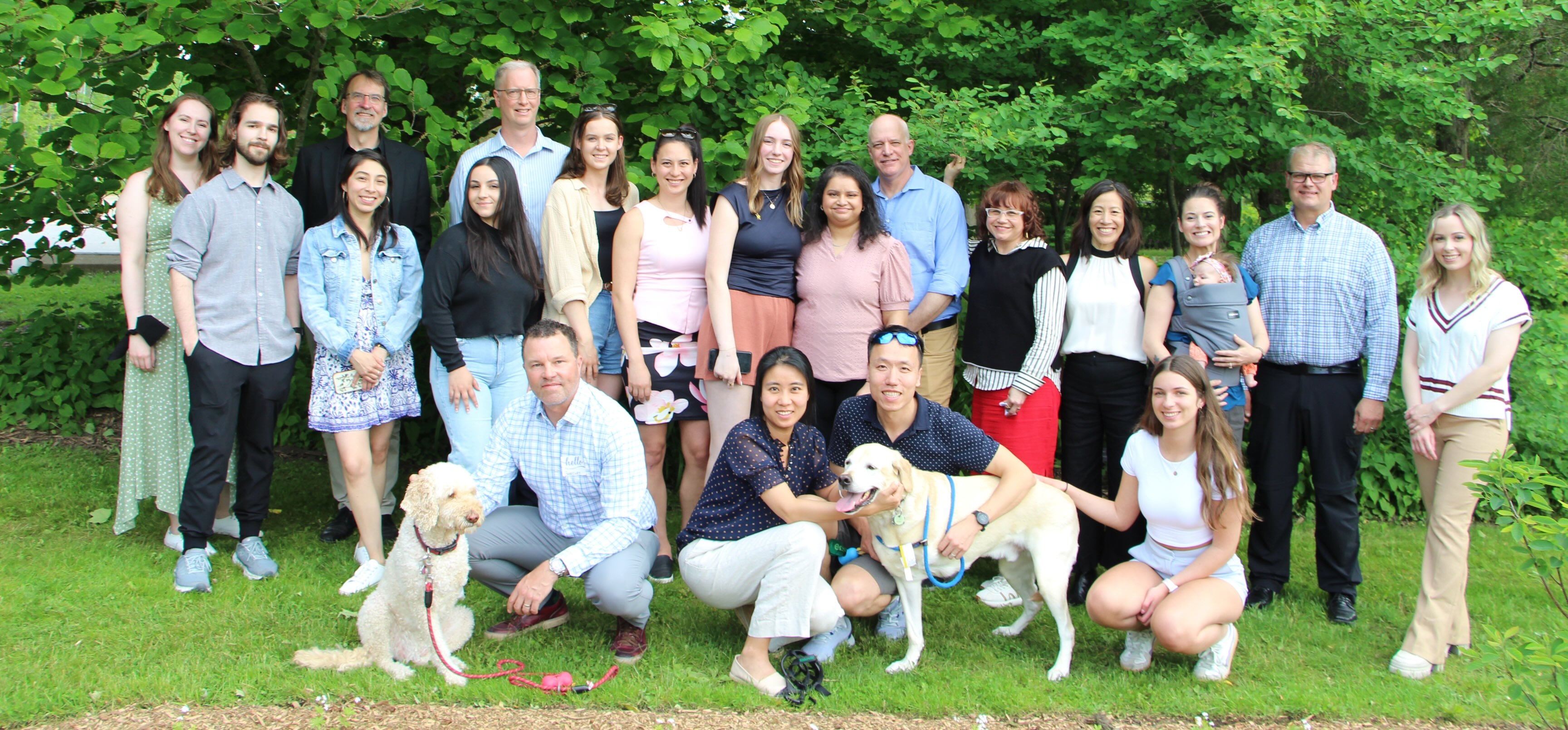
DOGBONe is continuing to bridge partners across disciplines and groups.
It held a first-of-its-kind event earlier this year that brought together scientists and osteosarcoma survivors – both human and canine – who shared personal stories of how this cancer has impacted their own lives, their loved ones and their pets.
The group continues in its ethos to directly connect those affected by osteosarcoma with the researchers who are advancing treatment today.
This vital project is supported by OVC Pet Trust and the Ontario Institute for Cancer Research.