
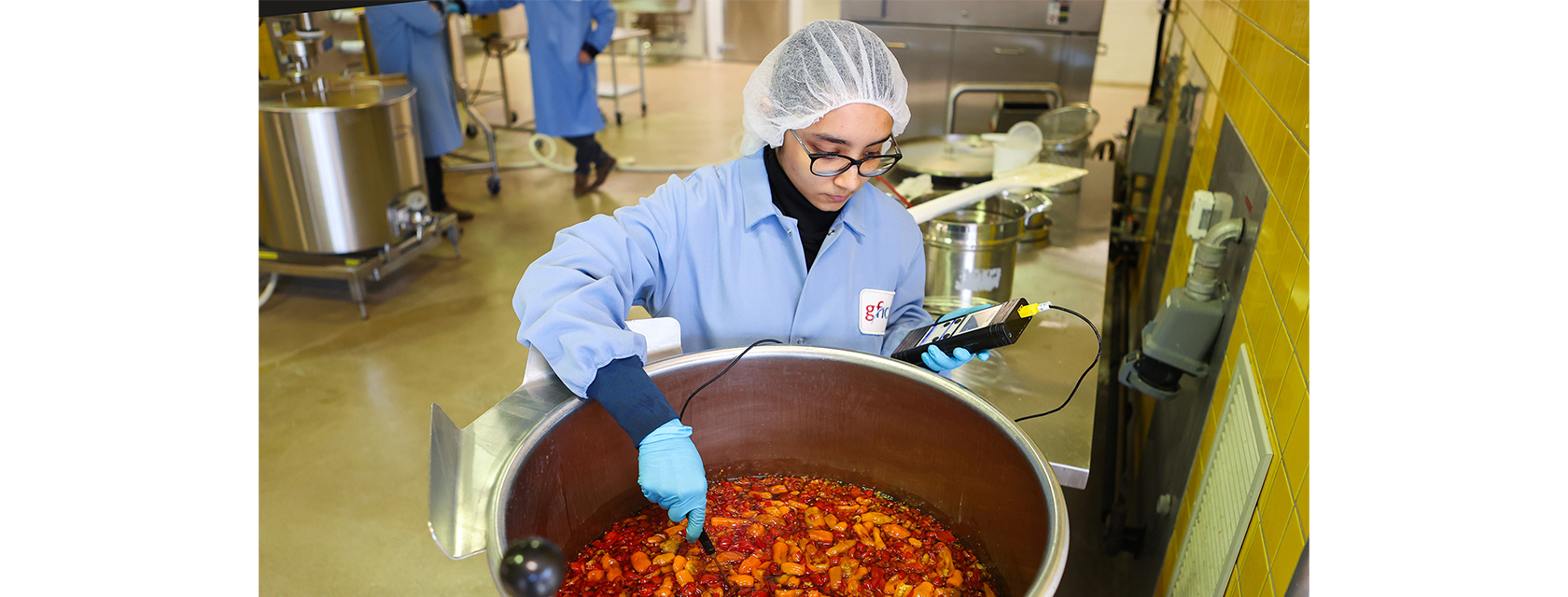
Food Day Canada is a day for all Canadians to celebrate the farmers, fishers, food researchers and home cooks who grow, produce and prepare the abundance of food in Canada.
Food Day Canada was founded more than two decades ago by Anita Stewart, the late food laureate of the University of Guelph. Her legacy lives on in the work done to maintain and improve Canada’s food systems.
A strong food system in Canada begins long before products end up in the grocery store. As Canada’s food university, U of G is at the forefront of the country’s food future, working on exciting innovations in crop development, animal and human health, technological advancement and education to prepare the next generation of agri-food leaders.
Here’s what U of G researchers say has them excited for what the future holds for Canada’s agri-food system.
Dr. Kari Dunfield – Harnessing the power within soil to feed Canada
Dr. Kari Dunfield is Canada Research Chair in Environmental Microbiology of Agro-Ecosystems, executive co-director of Soils at Guelph and a professor in the School of Environmental Sciences

At a time when Canadians are increasingly focused on building resilient, sustainable and local food systems, I believe some of the most exciting innovations are happening beneath our feet. The future of Canadian agriculture is changing the way we think about farming.
Rather than relying solely on external chemical inputs, we are learning to work with the natural biological processes that already exist in our soils. Healthy soils are living ecosystems, home to billions of microorganisms that play a critical role in supporting crop productivity, improving nutrient use efficiency, enhancing food quality and helping agricultural systems withstand challenges such as drought.
What excites me most is the opportunity to harness these biological systems to help farmers produce more with fewer resources. By better understanding and managing soil microbial communities, we can create agricultural systems that are both more productive and more sustainable, benefiting farmers, consumers, and the environment alike.
The University of Guelph is helping lead this transformation through research that connects scientific discovery with practical solutions for Canadian agriculture. We are working to build smarter, biology-driven systems. When soils are healthy, farms become more resilient, supply chains grow stronger and consumers enjoy healthier high-quality food.
It is the biological innovation happening in our soils- the breakthroughs that help farmers do more for less- that give me the greatest sense of hope. Canada’s food future is alive, growing and full of possibility.
Dr. Evan Fraser – Farmers investing in growing Canada’s food future
Dr. Evan Fraser is the director of the Arrell Food Institute and a professor in the Department of Geography, Environment and Geomatics

Every spring, farmers in Canada deploy about $20 billion in seeds and fertilizers. These become next year’s nutrition. Our health and our economy depend on this.
Each May, I head north with one of my daughters and the family dog for a spring ritual, to open the old family cottage. As I cross the Niagara Escarpment, I often see another spring ritual taking shape. This other ritual is entirely more consequential for the health and well-being of our country and happens when Canadian farmers start to prepare for the spring planting season. Planting the crops that become next year’s nutrition is a staggering investment. Collectively, our farmers spend about $20 billion in inputs such as seeds and fertilizers each spring. This investment is the foundation on which our food security and economic well-being rests ($150 billion is about what the sector generates). But rarely do most of us really take stock of this contribution either to our biological or economic health. Something similar happens on our lakes and oceans and on our range lands and forests as fishers, ranchers, hunters, and aquaculturists follow seasonal patterns to provide for us each and every day.
Canada has a bright food future, full of promise, innovation, health, nutrition, and environmental stewardship. We should all be excited to live in a country where the seasonal rituals of food production produce such bounty.
Dr. Jess Haines – Creating a healthier and more equitable food future
Dr. Jess Haines is the co-principal investigator of Food Uniting Neighbours (f.u.n.), co-director of the Guelph Family Health Study and a professor in the Department of Family Relations and Applied Nutrition

What excites me most is the growing national commitment to building a healthier, more equitable food system.
We’re seeing unprecedented federal investments and attention to food security, Indigenous food sovereignty and school food programs. These initiatives recognize that access to healthy food is fundamental to health, learning, community well-being and long-term economic prosperity.
If we can combine this policy momentum with strong research and meaningful community partnerships, I believe we can build a healthier and more equitable food future for everyone.
Dr. Stephen LeBlanc – Using technology to improve production, animal care
Dr. Stephen LeBlanc is the director of Dairy at Guelph and a professor in the Department of Population Medicine in the Ontario Veterinary College

In the dairy sector, Canada’s food future will develop and employ technology to meet consumers’ needs and care for animals ever more sustainably. Milk remains “nature’s most nearly perfect food,” with dairy products enjoyed by and nourishing people around the world.
Innovations in Canada and elsewhere will continue to find new ways to use milk to supply proteins through dairy products and supplemented in other foods and drinks. Dairy farms will continue to be at the leading edge of using cow-wearable sensors, cameras with computer vision and automated technology to support animal care, individualized nutrition and efficient use of labour and resources. Research will support progress towards net-zero production, while development and application of technology will keep the sector attractive for the next generation of farmers and industry professionals.
Dr. Sadaf Mollaei – Resiliency and innovation to strengthen Canada’s food system
Dr. Sadaf Mollaei is the Arrell Chair in the Business of Food and a professor in the School of Hospitality, Food & Tourism Management

What excites me most about Canada’s food future is the resilience and ingenuity I continue to see across our food system. In my own research, I have seen farmers, food businesses, and consumers respond to challenges not simply by adapting, but by finding new ways to strengthen the system.
Over the past few years, rising food costs, supply chain disruptions and climate-related pressures have tested every part of Canada’s food system. Yet these challenges have also sparked innovation. Farmers are adopting new practices to improve productivity and resilience. Food businesses are rethinking how they source ingredients, develop products and connect with consumers. Canadians are asking more thoughtful questions about where their food comes from and making purchasing decisions that increasingly reflect their values, whether around affordability, health, sustainability or supporting local producers.
What gives me the greatest optimism is the opportunity to build on this momentum. Lasting progress will come from creating the conditions that allow innovation to flourish: investing in research, supporting entrepreneurs and producers, and fostering collaboration among industry, governments, researchers and communities. When people across the food system have the knowledge, resources and partnerships they need, they are better equipped to develop solutions that are both practical and sustainable.
Food Day Canada celebrates the people who make our food system possible every day. Their creativity, adaptability, and commitment give me confidence that Canada’s food future will be one defined not only by resilience, but by continuous innovation and shared progress.
Dr. Youbin Zheng – Controlled environment agriculture for year-round access to fresh food
Dr. Youbin Zheng is a professor in the School of Environmental Sciences
What excites me most about Canada’s food future is the potential of controlled environment agriculture (CEA) to give Canadians year-round access to a greater diversity of fresh, nutritious, and culturally important foods.
To me, food is about much more than simply feeding people. It should provide the nutrients and beneficial compounds needed for health and well-being, while also bringing enjoyment to our lives. In our multicultural country, people are increasingly discovering and enjoying fresh produce from different cultures, many of which offer both excellent nutritional and nutraceutical value. Bitter melon, for example, is enjoyed as a vegetable fruit in many cultures and has been shown to have potential health benefits, including supporting blood glucose regulation and metabolism, which is especially beneficial to people with Type 2 diabetes.
Many of these crops are tropical or subtropical and are difficult to grow outdoors in Canada. I am excited that our world-class greenhouses and other CEA facilities, combined with Canadian expertise and innovation, can help change that. As climate change, long cold and dark Canadian winters, urbanization and trade disruptions create new challenges, CEA offers the opportunity to grow diverse fresh produce year-round, close to where people live, from remote northern communities to major urban centres. I believe this can help create a healthier, more sustainable and more resilient Canadian food system.